The Halo Effect of a Single Claim
The halo effect of a single food claim can steer a grocery choice. Learn to weigh the stated feature against the product’s taste, use, and your priorities.
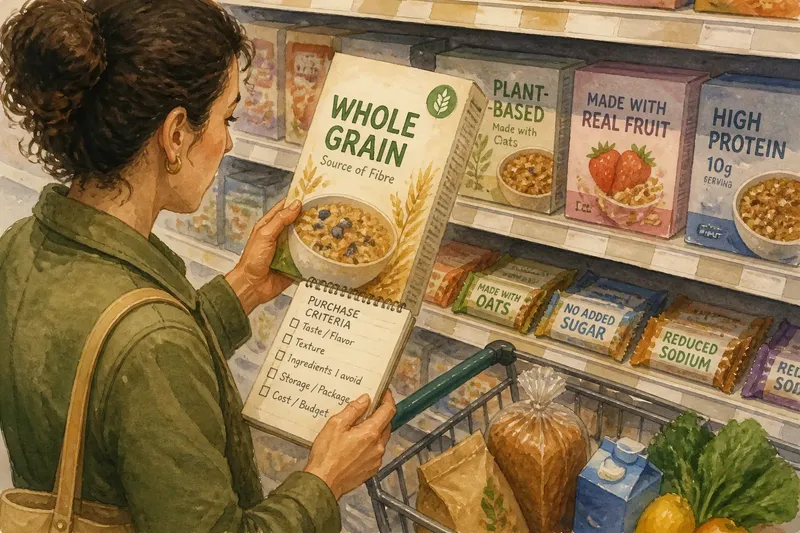
You reach for a cereal box marked “whole grain” before checking whether you like the flavor. The halo effect of a single food claim can make one appealing phrase stand in for a broader judgment; a short decision routine keeps the claim in its proper lane.
Set purchase criteria
Start with the job the food needs to do. A cereal for weekday breakfasts, a snack for a commute, and bread for toast call for different comparisons.
Choose a few relevant criteria before you shop: perhaps flavor, texture, ingredients you avoid, storage needs, package format, or cost within your budget. A claim may help with one question, but it cannot decide the others for you.
Separate claim from fit
Read a package phrase in its exact context. “Whole grain” concerns grain-related wording or content; it does not automatically tell you about taste, texture, every ingredient, or whether the product suits your routine. “Plant-based” can be used in different ways, so its meaning depends on the exact wording and surrounding product information; it does not, by itself, settle questions about ingredients, nutrition, or personal suitability.
Other phrases also have limits. “Made with real fruit” does not describe every ingredient, “no added sugar” does not necessarily mean sugar-free, and “high protein” does not establish that a food is right for your needs. For a comparison such as “reduced sodium,” check what the claim is being compared with and consult the relevant package details.
Compare at the shelf
When a claim catches your attention, ask what specific question it answers. Then compare the details that matter for your purchase, using the ingredient list or nutrition information when relevant. You do not need to inspect every line; look where the claim leaves a practical question open.
Say you want a portable afternoon snack and consider a bar labeled “made with oats.” You want something that travels neatly, tastes good to you, and fits your budget. On checking the options, you see that the oat bar is crumbly, while another bar has a texture you prefer and also fits your budget. For this particular job, the second bar better meets your stated criteria; the oats wording has not answered the portability question.
Questions about claims?
Does “natural” mean healthier?
Not by itself. The term’s meaning can depend on the product and applicable rules, and it does not settle questions about nutrition, taste, or ingredients.
Is “no added sugar” sugar-free?
Not necessarily. The wording addresses added sugar, while a food may contain sugars from its ingredients; check the package information relevant to your question.
Does “high protein” make a product a good choice?
It signals that protein is being emphasized, but does not establish whether you like the product or whether it suits your needs. Compare it with the criteria you chose for this purchase.
What if a claim’s meaning is unclear?
Check the exact wording and related product information rather than assuming that a familiar phrase has one fixed meaning. If the decision depends on a formal label definition or a dietary need, consult the applicable rules or a qualified professional.
Keep useful preferences
After using a product, note the concrete mismatch, if there was one: perhaps the flavor did not suit breakfast, the package was awkward to store, or the food did not travel well. That observation can refine your next purchase without turning one experience into a verdict on the claim or on every similar product.
- Observation: the cereal’s flavor does not suit your breakfasts. If flavor is a priority, choose a different flavor or compare another cereal; otherwise, keep it for a use where the taste works.
- Observation: the snack crumbles in your bag. If a tidy commute snack matters, choose a sturdier format; otherwise, keep the crumbly one for eating at home.
- Observation: the package takes more storage space than you have. If storage is a constraint, choose a smaller or easier-to-store package; otherwise, keep the product and adjust where you store it.
- Observation: an ingredient listed on the package is one you avoid. If avoiding it is necessary, choose another product; otherwise, decide whether the remaining features still suit your preferences.
- Observation: a “reduced sodium” claim does not clarify the comparison you care about. If the comparison matters, check the stated basis and relevant nutrition information; if it remains unclear, choose a product whose details answer your question.
- Observation: a “plant-based” phrase leaves you unsure about a particular ingredient. If that ingredient matters to your choice, check the ingredient list or manufacturer information; if you cannot resolve the question, choose an option with clearer details.
For a worked example, imagine you buy a hypothetical “whole grain” cereal for breakfast because the phrase caught your eye. At home, you find that its flavor does not suit your morning routine, though you still want a cereal whose grain-related wording matters to you. Before the next shop, you write down three criteria: that wording, a flavor you enjoy, and a package that fits your cupboard. You compare those details on two options and choose the one that fits all three; if neither does, you can keep looking rather than letting the claim settle the choice.
For the next purchase, keep the claim as one piece of information and carry forward the preferences that proved useful. The halo effect of a single food claim is easiest to spot when you can name the actual job, such as a cereal you enjoy at breakfast or a snack that stays intact in your bag.